Iambic Pentameter
What iambic pentameter is, how to scan a line by marking stresses, the common variations in Shakespeare, and why ten syllables alone do not make a line iambic.
Iambic pentameter is a line of verse built from five iambs, and an iamb is an unstressed syllable followed by a stressed one, the rhythm of da-DUM. Five of them in a row give a line of ten syllables that rises and falls like a heartbeat: da-DUM da-DUM da-DUM da-DUM da-DUM. This guide shows how to hear that pattern, how to mark it on the page (called scanning), and how real poets bend it.
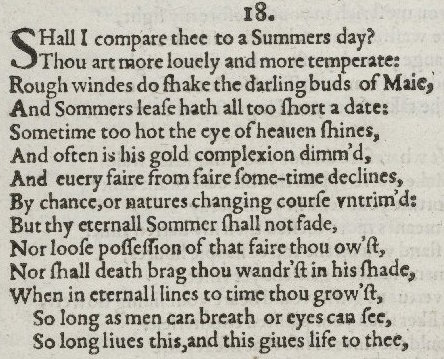
What the term means
The name has two halves. Iambic describes the foot, the repeating unit: an unstressed syllable then a stressed one, according to Britannica’s entry on iambic pentameter. Pentameter describes the length: Wikipedia notes that each line has five metrical feet. Because an iamb has two syllables, a regular line usually has ten.
In the notation below, x marks a weak syllable and / a strong one, and capitals show the stressed syllable in each foot. Stress means the syllable that gets the push when you say the word naturally. In re-PORT the second syllable carries it; in TA-ble the first does. If you are unsure what a syllable is or how to split a word, start with What Is a Syllable? and How to Count Syllables. Scansion needs a reliable syllable count before it can say anything about stress.
Shakespeare famously used it in his plays and sonnets, and the first line of Sonnet 18 in the picture above is a standard example: Shall I compare thee to a Summer’s day? Read aloud, it falls into five iambs: shall I | com-PARE | thee TO | a SUM- | -mer’s DAY, which is x / | x / | x / | x / | x /. Stress is relative: small words such as thee and to get a lighter beat than the content words around them, and readers sometimes weigh them differently.
How to scan a line, worked through
Scanning means writing the stress pattern over the line and checking it against da-DUM. Here is a line written for this page, so it is not borrowed from any poet:
The quiet river waits beneath the hill
- Count the syllables first. Put the line into the Syllable Counter or count by hand. The (1) qui-et (3) riv-er (5) waits (6) be-neath (8) the (9) hill (10). That makes ten, so the line is at least the right length.
- Get a hint from the stress digits. The Syllable Counter shows a stress pattern for each word it looks up, taken from the CMU Pronouncing Dictionary, which marks each vowel with a digit: 0 means no stress, 1 means primary stress and 2 means secondary stress. For these words the digits are quiet 10, river 10, beneath 01, waits 1 and hill 1. Treat them as a hint, not a verdict: the dictionary shows a word spoken alone and cannot know which word you mean to emphasise.
- Read the line aloud and tap it. Say it at normal speed, as you would to a friend. Your voice should lift on the same syllables the digits flagged.
- Write the pattern. Mark each syllable with x or / and divide the line into feet.
| Foot | Syllables | Pattern |
|---|---|---|
| First | the QUI- | x / |
| Second | -et RIV- | x / |
| Third | -er WAITS | x / |
| Fourth | be-NEATH | x / |
| Fifth | the HILL | x / |
Every foot is x / (weak, strong), so this line is a perfectly regular iambic pentameter. Most good poetry is not this regular, and that is deliberate, as the next section shows.
Common variations
A poem that kept the rhythm perfectly through every line would sound mechanical, so poets vary it, and a line with a variation is still counted as iambic pentameter. Three are worth knowing first, all described in Wikipedia’s article on the form.
- Substitution (inversion). A foot is flipped so the stress comes first (DUM-da, a trochee). It is most common in the first foot, which the article says “often changes by the use of inversion”. Only the first foot is flipped in Silent the river waits beneath the hill: SI-lent | the RIV- | -er WAITS | be-NEATH | the HILL, which is / x | x / | x / | x / | x /. It is still ten syllables and still iambic pentameter. Other substitutions exist, such as two stresses together (a spondee) or two weak syllables together (a pyrrhic), and they let the sense of the words override the beat.
- Feminine ending. The line gains a final unstressed syllable, which the article describes as “the addition of a final unstressed syllable, which creates a weak or feminine ending”. The line then runs to eleven syllables. Hamlet’s To be, or not to be, that is the question is the famous case: it ends on the weak syllable -tion. A common scan is to BE | or NOT | to BE, | THAT is | the QUES- | -tion, x / | x / | x / | / x | x / | x: four iambs, an inverted fourth foot and the extra weak syllable.
- Inversion after a pause. A pause in the line (a caesura) is the other common place for a flipped foot. Wikipedia says of the Hamlet line, “This line also has an inversion of the fourth foot, following the caesura”, and adds, “In general a caesura acts in many ways like a line-end: inversions are common after it.”
The practical rule: judge a line by how it sits against the da-DUM pattern, not by whether every foot matches. A line with one flipped foot or an extra last syllable still reads as iambic pentameter because the pattern is still the thing your ear expects.
Counting syllables as spoken
Real verse does not always give ten syllables on the page. Poets can merge two vowels into one beat, an effect called elision; Wikipedia says an extra syllable in Donne’s final foot “can be read as an anapest (dada DUM) or as an elision”. So treat the written syllable count as a starting point, and let the line as spoken in verse decide the count that matters.
Ten syllables does not make a line iambic
This is the mistake the syllable counter cannot catch. Length is only half of the definition; the stresses have to alternate. Here is a line of exactly ten syllables that is not iambic pentameter:
Seven hungry children ate the whole cake
Counting gives ten: sev-en (2) hun-gry (4) chil-dren (6) ate (7) the (8) whole (9) cake (10). But the stresses fall SEV-en HUN-gry CHIL-dren ATE the WHOLE CAKE, in the pattern / x / x / x / x / /. It opens on a stress and alternates strong-weak, the opposite of da-DUM, and ends with two strong syllables in a row, so there are not five iambs.
The reverse also holds: a line of eleven syllables can be iambic pentameter, as with a feminine ending. So the sequence that works is: count first with the Syllable Counter, use the stress digits as a hint for which syllables are strong, then trust your own ear reading aloud. When you need words that put the stress where an iamb wants it, the stress-pattern table in 3 Syllable Words shows how three-syllable words fall against the beat.
Checking your own line
When you are writing rather than reading, run the same sequence backwards. Draft the line, count the syllables, then read it aloud and mark where your voice naturally pushes. If a stressed word sits where an unstressed beat should be, swap in a synonym with the stress in the right place, or move the word. If the line stumbles on one foot only, check whether it is a deliberate inversion that suits the meaning before you fix it. Many successful lines keep exactly such a stumble.